B.A.S.S. – Balance. agility. strength. stretching
BEACH B.A.S.S for Week 8 - Nifty Necks
By sarah kelliher
Your neck doesn’t have to do all the work!
Driving, working at the computer, reaching overhead, carrying bags or lying comfortably on the beach. Your neck and shoulders have plenty to do every day.
But looking after your neck isn't just about exercising your neck.
This week, Sarah shares two important secrets: posture and muscle strength.
Quick check
Where is your head right now?
Is it balanced comfortably above your shoulders, or has it drifted forwards towards your screen?
Now gently imagine your head floating upwards, like a helium balloon attached to a string.
Does that change how your neck and shoulders feel?
Why this matters.
Secret 1: Posture
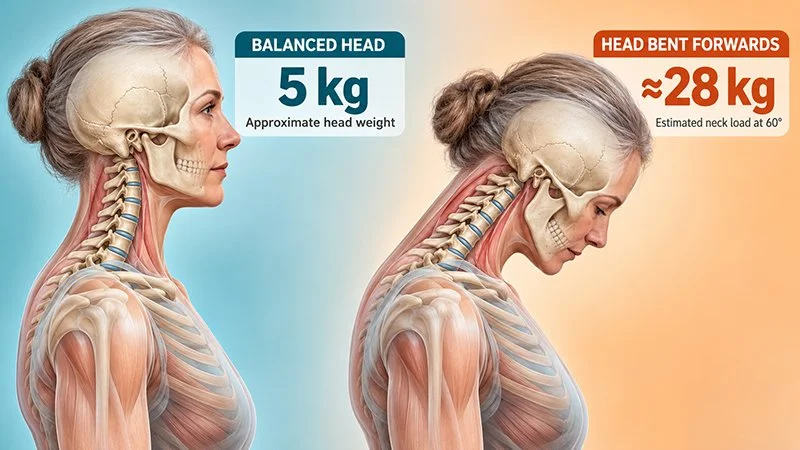
Your head weighs approximately 4.5–5 kg. When it's balanced above your shoulders, your neck muscles can manage that weight more efficiently.
But here's the surprising bit. When you bend your head forward by 60 degrees, like looking down at your phone, one biomechanical study estimated the load on your neck could increase to the equivalent of approximately 28 kg!
Your head hasn't actually gained weight, but your neck muscles and surrounding structures have to manage much greater forces.
That's why being aware of where your head sits can make a difference, particularly when you're reading, driving or using your phone.
But posture isn't about holding yourself rigidly upright all day. It's about your brain knowing where your body is in space, and your muscles being able to find and maintain useful positions.
For our more flexible or 'floppy' clients, finding that balance can be challenging. Think of a seal balancing a ball on its nose!
For our stiffer or 'flippy' clients, mobility may need some attention before a comfortable position becomes easier to achieve.
Sarah has three familiar reminders:
Shine your light.
Widen your dots.
Float your head.
Which cue works best for you?
Secret 2: Muscles
Your neck doesn't work in isolation.
Several muscle groups help share the load:
Arm muscles: Give you strength to lift, carry, push and pull.
Rotator cuff muscles: Help control and stabilise your shoulder as your arm moves.
Scapular stabilisers: Position and control your shoulder blades when you reach, lift and move your arms overhead.
Deep neck flexors: Help control and stabilise the position of your head and neck.
Research supports exercise, particularly strengthening the neck and shoulder region, as an effective part of managing persistent neck pain.
When these muscles have the strength and coordination to work together, everyday activities such as carrying shopping or reaching into a cupboard can become easier.
What to do this week
Start with Sarah's two secrets.
1. Check your posture. Notice where your head sits when you're reading, driving or using your phone. Try your favourite Physiocise posture cue and see what changes.
2. Think beyond your neck. Are your shoulders and arms strong enough for the things you ask them to do? Consider how your regular B.A.S.S. exercises help you build strength and control.
Watch this week's video to put these ideas into practice through Balance, Agility, Strength and Stretch.
This week's cue
Float your head.
Think helium balloon and string. Find a comfortable balance rather than forcing yourself to sit up straight.


Book For Next Term
Next term is open for booking. Join us to build strength, move with confidence, and keep doing what matters most.
Select your location below and book now.