B.A.S.S. – Balance. agility. strength. stretching
BRAIN B.A.S.S for Week 7 - Make More Brain Tracks
BY DIMITY THOMPSON
We all have movement patterns we use without thinking. That is part of how the brain makes movement efficient. When we walk, reach, turn or get out of a chair, we do not need to plan every detail. The movements we practise regularly become familiar, easy and automatic.
A problem can arise when pain or habit narrows the way we move too much, so we start relying on the same few patterns over and over. When we add some variety, our brain and body have more ways to move comfortably and adapt to what we are doing.
Start with a quick check
Roll your shoulders a few times. Can you clearly feel where your shoulder blades are moving? Can you change the direction or size of the movement?
Now move your hips in a slow figure of 8. Does one direction feel easier or more familiar than the other?
These small differences give us useful information about which movements feel well practised and which ones may be less familiar.
Why this matters
Your brain contains a map of your body, often described as the homunculus. Some body parts, such as your hands, have a very detailed representation. Other areas, including the ribcage and shoulder blades, are less clearly represented. You can see the unusual shape of the homunculus man below. Each body part is drawn in proportion to how much space it takes up in the brain’s sensory map.
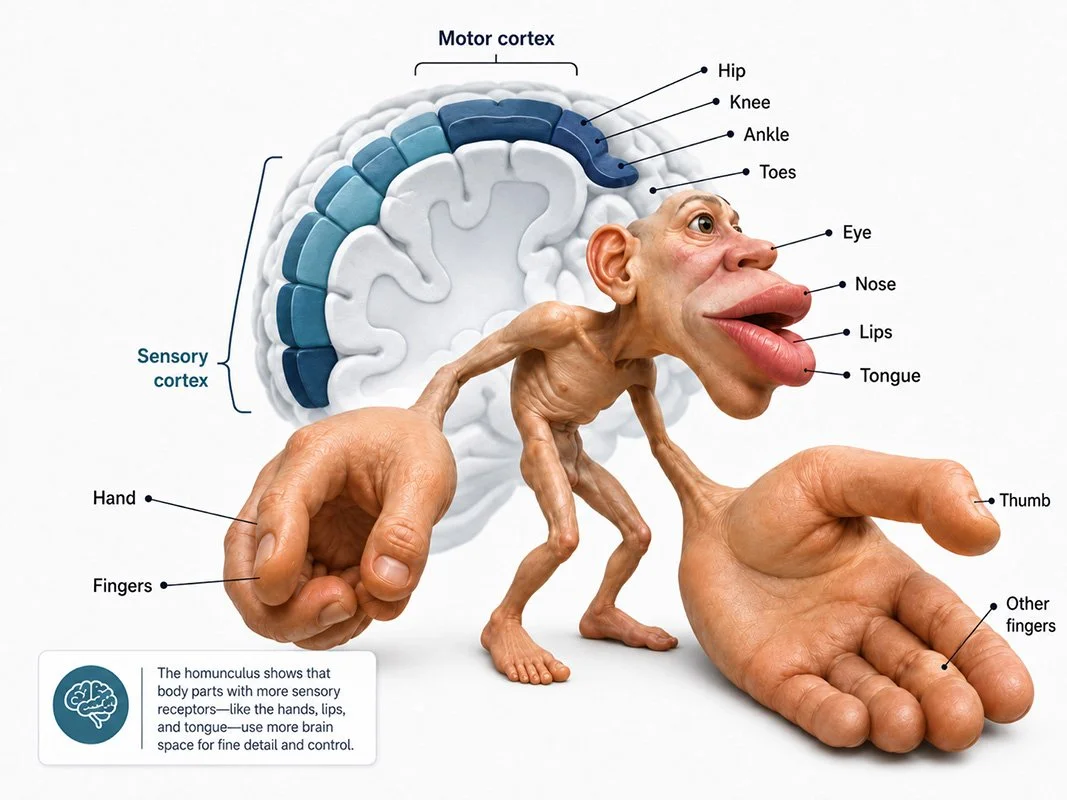
These brain maps are not fixed. They change depending on how much we use and pay attention to different parts of the body.
When an area is painful, we often start protecting it. We may move it less, avoid certain directions or repeatedly use the movement that feels safest. Over time, the brain receives less variety of information from that area, and its body map can become less precise. This is sometimes described as smudging.
The beach-track analogy helps explain it.
Imagine driving along soft sand. Once you have made a track, it is easier to follow it again. Keep using the same track and it becomes even more familiar. That is useful. Our brains are designed to make commonly used movements easier and more automatic.
The issue comes when pain means we keep using only the same narrow track. Other ways of moving are used less, so we have fewer familiar options available.
The aim is not to get rid of the well-worn track. It is to create more tracks, so the brain has a broader range of movement patterns to choose from.
What to do this week
Try two simple movement experiments.
Shoulder blade rolls
Move your shoulder blades slowly and notice where they travel. Try changing the direction or size slightly. Using a mirror can give your brain extra visual information about what is moving.
Figure-of-8 hips
Move your hips in a smooth figure of 8. Notice whether one direction feels easier, then explore the less familiar direction comfortably.
Practise them briefly and regularly rather than trying to make the movements large or complicated.
You might also choose another familiar movement and vary it slightly. Reach in a different direction, turn a different way or change how you shift your weight.
The goal is not to stop movement becoming automatic. It is to build plenty of useful movement patterns, so your brain and body have more options when you reach, walk, turn or need to adapt to something different.
This week’s reminder:
More ways to move.
Watch this week’s video below to learn more and put this week’s Brain B.A.S.S. challenge into practice.

BOOK for next Term
We have opened bookings for next term's classes.
If we have your credit card saved in our encrypted system and you would like to re-book your usual class for next term, use the link below.